Starting as a CELTA tutor is exciting, but it can also feel like stepping into a very intense professional role. There are lesson plans to read, teaching practice sessions to observe, assignments to mark, feedback to write and trainees to support, often within a very tight schedule.
In this reflection, I share what I learnt from tutoring my first full-time online CELTA course: the challenges I faced, the systems that helped me and the moments that reminded me why teacher training is such meaningful work. I hope these thoughts will be useful for newly qualified CELTA tutors, teacher trainers and English teachers who are interested in professional development and English teachers looking into how to become a CELTA tutor.
If you are also developing as a teacher or teacher trainer, structured support can make a real difference. At our language school, we offer teacher development opportunities for professionals who want to strengthen their methodology, confidence and reflective teaching practice.
What does a CELTA tutor do?
A CELTA tutor supports trainee English teachers during their course by observing teaching practice, giving feedback, guiding reflection, supporting lesson planning and helping trainees develop professionally.
What are the biggest challenges for a new CELTA tutor?
For a new CELTA tutor, the biggest challenges are often time management, marking assignments confidently and giving feedback that is both supportive and focused. A full-time CELTA course moves quickly, so tutors need clear systems, realistic priorities and the ability to help trainees improve step by step rather than overwhelming them with too many action points at once.

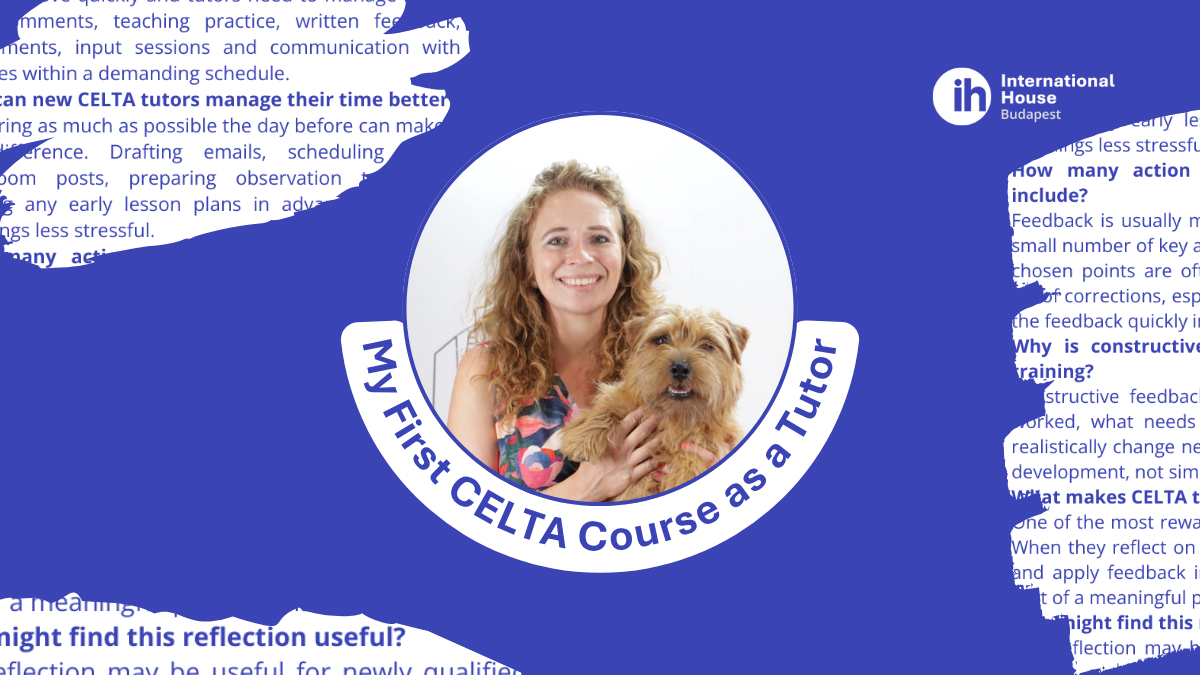
Meet our trainer:
Urszula Staszczyk
My ELT journey began many years ago in Poland, where I started out as an English teacher. What followed was a wonderful adventure through EFL management and teacher training in Spain and the UK, eventually bringing me to beautiful Budapest. It was here that I was introduced to the IH Teacher Training Department and embarked on my latest challenge and passion: becoming a CELTA trainer.
I hold an MA in English Literature, a BA in English Language Teaching, and a DipTESOL qualification.
When I’m not in the classroom or in front of a laptop running an online CELTA course, you’ll probably find me in a cosy café, coffee in hand and a good book nearby. If not, there’s a good chance I’m at an airport, getting ready for my next trip. I also love dogs and regularly take part in dog shows across Europe.
Reflections of a New CELTA Tutor
Hi, I’m Ula, a teacher and teacher trainer at International House Budapest.
This year, I began a new chapter in my professional journey – as a CELTA tutor. I completed my training just before Christmas and in January I had the opportunity to tutor my first full-time (FT) online CELTA course.
It was an intense, challenging and incredibly rewarding experience. In this post, I’d like to share a few reflections from my first course – the challenges I encountered, the aspects I especially enjoyed and some practical tips that I think will be helpful for other newly qualified CELTA tutors starting out.
The Biggest Challenges for a New CELTA Tutor
Doing everything in a timely manner was probably the biggest challenge.
I originally trained on a part-time course where trainees submitted their lesson plans by 8 pm the day before. That suited me perfectly. I could read through the LPs and leave my comments the evening before the TPs.
This time, however, I was tutoring on a full-time course, where lesson plans were due at 8:15 in the morning. In theory, at least. In practice… Well, not always
On top of that, mornings for a tutor include a whole list of tasks: emailing students with materials, posting the observation task on Google Classroom and, of course, commenting on the LPs themselves. I quickly realised that if I wasn’t sitting with a coffee at my desk at 8am sharp, the mornings could become rather stressful.
One small thing that helped considerably was preparing as much as possible the day before. I now keep the student email ready in my drafts folder so I only need to add attachments in the morning. The same goes for Google Classroom posts and observation tasks – both can be prepared in advance and scheduled. And if any lesson plans arrive the evening before (which does sometimes happen!) I make sure I go through them before going to bed.
I faced other time-related challenges, too. At first, I also found it tricky to have my written feedback fully polished immediately after TP. I would draft my comments, but I still wanted a few minutes to reread them, fix the occasional typo and make sure the tone was supportive.
However, after TPs, I usually had just enough time for a quick lunch, walking my dog before heading to school and other work duties and life admin. If I didn’t finish the feedback there and then, I knew that by the evening I would be significantly more tired – and significantly less enthusiastic about working on it.
I found it useful to build in a short “feedback buffer” straight after feedback. Even just 10 minutes to ‘polish’ my comments while the lesson was still fresh in my mind made a huge difference!
Tip for new tutors
Build in an extra 10 minutes after feedback to tidy up and refine your notes while everything is still fresh.
Marking Assignments Accurately
Marking assignments was another area that I found quite challenging.
First of all, I don’t yet know the assessment criteria by heart – and that definitely slowed me down. I found myself rereading the criteria and guidelines a few times and making sure I was interpreting everything correctly (and sometimes, I would have to consult the Main Course Tutor, MCT). I wanted to evaluate as fairly and accurately as possible, which meant it sometimes took longer than I expected.
How to Streamline the CELTA Marking Process?
I created my own simple checklist based on the official criteria. Having a quick-reference version ready to consult beside me made the process faster and gave me more self-assurance in my decisions.
Tip for new tutors
Create your own checklist based on the official assessment criteria – it will streamline the marking process and help you make decisions more efficiently.
Writing Constructive Feedback and Choosing Focus
Writing feedback that is constructive and supportive – while also choosing the right focus – at times turned out to be more challenging than I expected.
Sometimes a lesson was clearly not so successful and I could easily identify five or six areas for improvement. But overloading a trainee with too many action points would only create stress and frustration. The challenge then for me wasn’t noticing what needed improvement but to decide:
- What is vital to address now?
- What can realistically be improved by the end of the next TP?
We need to remember that effective feedback means helping someone move forward in manageable steps. So if I happened to write more than 3-4 action points, I would then ask myself, If the trainee improves just one thing next time, what will make the biggest difference to their learning? That question helped me prioritise and focus my feedback.
Tip for new tutors
Limit your feedback to 3-4 key action points and keep this question in mind: What will make the biggest difference to learning? – this will help you prioritise and keep feedback more manageable.
Why focused feedback matters in teacher training
In teacher training, feedback needs to be clear enough to guide improvement, but manageable enough for the trainee to act on. A long list of problems may be accurate, but it is not always useful. Trainees are often processing a lot at once: lesson planning, classroom management, language analysis, procedures, timing, interaction patterns and their own confidence.
This is why prioritising feedback is so important. A tutor’s role is not simply to notice everything, but to identify what matters most at that stage of the trainee’s development. When feedback is focused, trainees are more likely to understand it, remember it and put it into practice in their next lesson.
What I Enjoyed Most: Input Sessions & Trainee Development
I always try to make my sessions as interactive and trainee-centred as possible. I understand that after a full day of TP, feedback and ALP, it can be hard to stay focused. So my aim was always to create something that would spark discussion, invite reflection and keep the energy in the Zoom classroom alive.
And I have to say I was pleased with most of my input sessions. Seeing real discussion emerge was incredibly rewarding. When trainees start to challenge ideas, share classroom experiences and build on each other’s thoughts, you know the session has moved beyond “input” and start to become genuine professional dialogue.
And hearing at the end that the session was useful – especially after a long day – is the best thing you can hear at 5 PM!
Being part of the process
The second thing I truly enjoyed was being part of the trainees’ development process.
What I found especially meaningful was helping trainees generate their own ideas about how to improve. Not just telling them what to fix, but guiding them to reflect, identify priorities and experiment with new approaches. And then seeing them put those action points into practice – sometimes in small steps, sometimes in bigger leaps – was genuinely satisfying.
Of course, progress didn’t look the same for everyone as some changes were subtle and some were more explicit but being part of someone’s professional growth – even for just a few intense weeks – is a great honour. And for me, that’s what makes being a CELTA tutor truly worthwhile 🙂
Looking back, my first CELTA course as a tutor was both demanding and deeply rewarding. It challenged me to become more organised, to prioritise effectively and to support trainees in manageable, meaningful steps – all good practice whether you’re a teacher, a teacher trainer, or both! I’m still at the beginning of my CELTA tutor journey, but I’m thrilled to see what the next course will bring (with slightly better systems in place – and coffee definitely ready at 8 am).
Frequently Asked Questions About CELTA Tutoring
What is the biggest challenge for a new CELTA tutor?
The biggest challenge is often time. Full-time CELTA courses move quickly and tutors need to manage lesson plan comments, teaching practice, written feedback, assignments, input sessions and communication with trainees within a demanding schedule.
How can new CELTA tutors manage their time better?
Preparing as much as possible the day before can make a big difference. Drafting emails, scheduling online classroom posts, preparing observation tasks and reading any early lesson plans in advance can make mornings less stressful.
How many action points should CELTA feedback include?
Feedback is usually more effective when it focuses on a small number of key action points. Three or four carefully chosen points are often more manageable than a long list of corrections, especially when trainees need to apply the feedback quickly in their next teaching practice.
Why is constructive feedback important in CELTA training?
Constructive feedback helps trainees understand what worked, what needs improvement and what they can realistically change next. It should support reflection and development, not simply point out mistakes.
What makes CELTA tutoring rewarding?
One of the most rewarding parts is seeing trainees grow. When they reflect on their teaching, try new approaches and apply feedback in later lessons, the tutor becomes part of a meaningful professional development process.
Who might find this reflection useful?
This reflection may be useful for newly qualified CELTA tutors, experienced teachers moving into teacher training, CELTA trainees who want to understand the tutor perspective and language schools interested in reflective teacher development.
Expert summary
My first CELTA course as a tutor showed me that effective teacher training depends on organisation, clarity and empathy. The practical systems matter, preparing materials, using checklists, managing feedback time, but so does the human side of the role. Supporting trainees means helping them reflect, prioritise and make progress in realistic steps. That balance between structure and support is what makes CELTA tutoring both demanding and deeply rewarding.
Interested in teacher development?
If you are a teacher, future teacher trainer or language professional looking for practical development, we would be happy to support you. Contact our team to learn more about our teacher training courses, methodology workshops and personalised development options.
Whether you are at the beginning of your teaching journey or ready for the next professional step, the right training can help you build confidence, reflect more deeply and develop practical classroom skills.